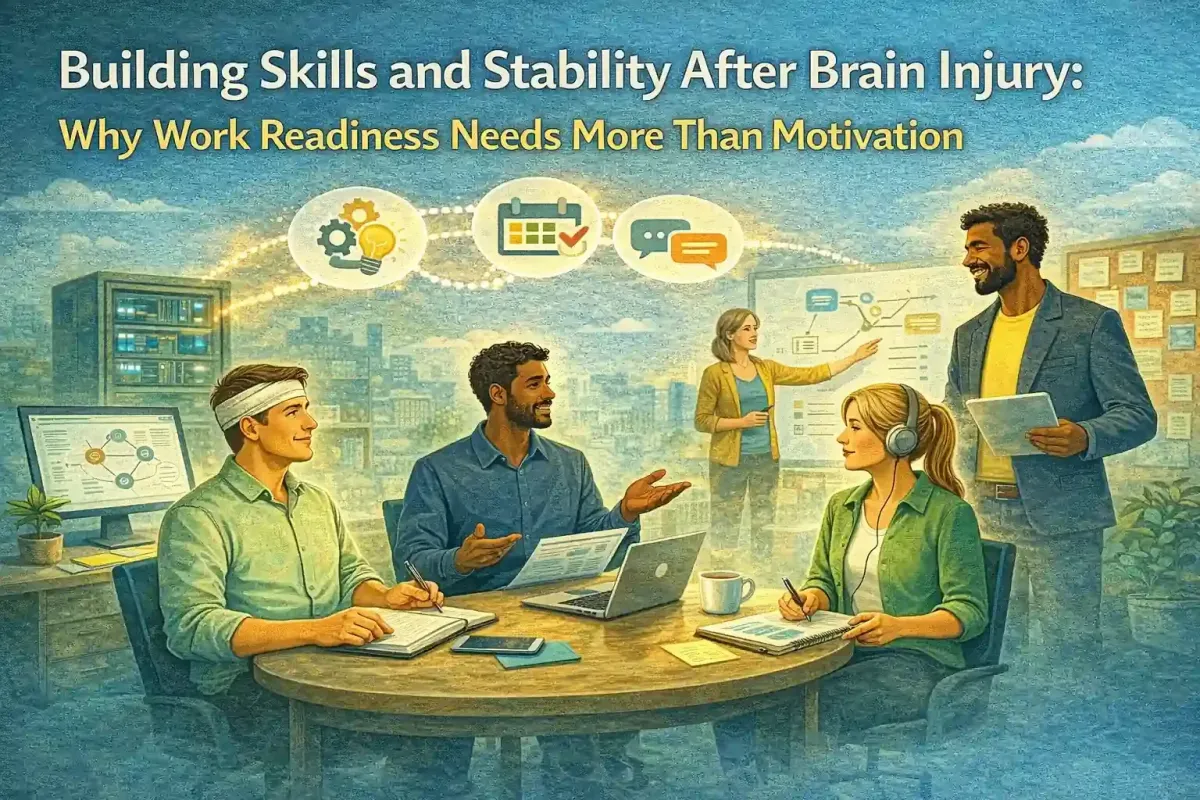
Building Skills and Stability After Brain Injury: Why Work Readiness Needs More Than Motivation
Recovery after acquired brain injury is often framed in medical terms: appointments, rehab milestones, symptom tracking, and the slow return of physical capacity. But for many people, the hardest part begins after the acute phase—when life is expected to “resume” without acknowledging how fundamentally the rules have changed.
Employment and skills development sit at the centre of this next chapter. Not because work is the only marker of recovery, but because work shapes identity, financial stability, social connection, and long-term independence. The challenge is that brain injury recovery rarely follows the linear pathways our workplaces are designed for. The result is a mismatch: people who are capable, motivated, and intelligent still find themselves excluded by systems that don’t recognise cognitive fatigue, communication changes, or the emotional load of re-entering public life.
GNR Media often covers how growth systems depend on structure, repeatability, and sustainable processes—and that same principle applies in personal recovery. When rebuilding capacity after injury, progress comes less from heroic effort and more from consistent, supported skill-building over time.
The hidden employment gap in brain injury recovery
A major barrier to returning to work after brain injury is invisibility. Unlike a broken limb, cognitive impacts can be subtle to outsiders while remaining deeply disruptive to the person experiencing them. Memory lapses, slower processing speed, sensory overload, or difficulty with executive functioning can make ordinary tasks feel unpredictable.
In employment settings, these changes can be misread as poor performance, lack of confidence, or disengagement. People may also struggle with “masking”—working harder to appear normal, which accelerates fatigue and can lead to burnout. The pressure to prove readiness often creates a damaging cycle: returning too early, collapsing, then withdrawing again.
From a skills perspective, the recovery journey is not simply about regaining what was lost. It can involve building new strategies—learning how to manage energy, communicate limitations without shame, and work with different cognitive rhythms. These are skills, not personal flaws. Yet they are rarely taught in conventional employment pathways.
Work readiness as a long-term skills project
Traditional employment preparation tends to focus on resumes, interviews, and technical competencies. For people recovering from brain injury, those matter—but they sit on top of more foundational capacities that determine whether work is sustainable.
These include pacing, boundary-setting, emotional regulation, and the ability to anticipate triggers such as noise, multitasking, or time pressure. Even confidence itself is often skills-based: it grows when someone has reliable tools for navigating setbacks.
Work readiness also requires social safety. A person can have strong coping strategies and still struggle in environments that demand constant speed and uninterrupted availability. This is why skills development must be paired with realistic job design, supportive leadership, and clear expectations.
At a community level, Australia’s workforce conversations increasingly include inclusion, adaptability, and neurodiversity. But brain injury often sits outside those discussions—despite its prevalence and its overlap with cognitive and sensory differences. Treating recovery as a skills project rather than a medical afterthought helps bridge that gap.
The role of lived experience education in workplace stability
One of the most effective ways to build understanding is through lived-experience storytelling. Not as inspiration, and not as charity—but as practical education that translates invisible challenges into real workplace implications.
Programs such as those offered through trauma recovery and resilience initiatives can provide context for how recovery affects employability, decision-making, communication, and long-term confidence. For employers and communities, this kind of education helps replace assumptions with clarity. For survivors and carers, it reinforces that the struggle is not personal weakness—it is a system learning curve.
This matters because workplace stability depends on shared language. When teams understand fatigue, sensory overload, and cognitive variability, they can design workflows that prevent harm. When they don’t, even well-meaning environments can become unsafe.
GNR Media’s own writing on sustainable systems highlights that stability is built, not wished for. The same applies here: returning to work after brain injury becomes more achievable when skills development, employer education, and realistic expectations move together—quietly, consistently, and with dignity.