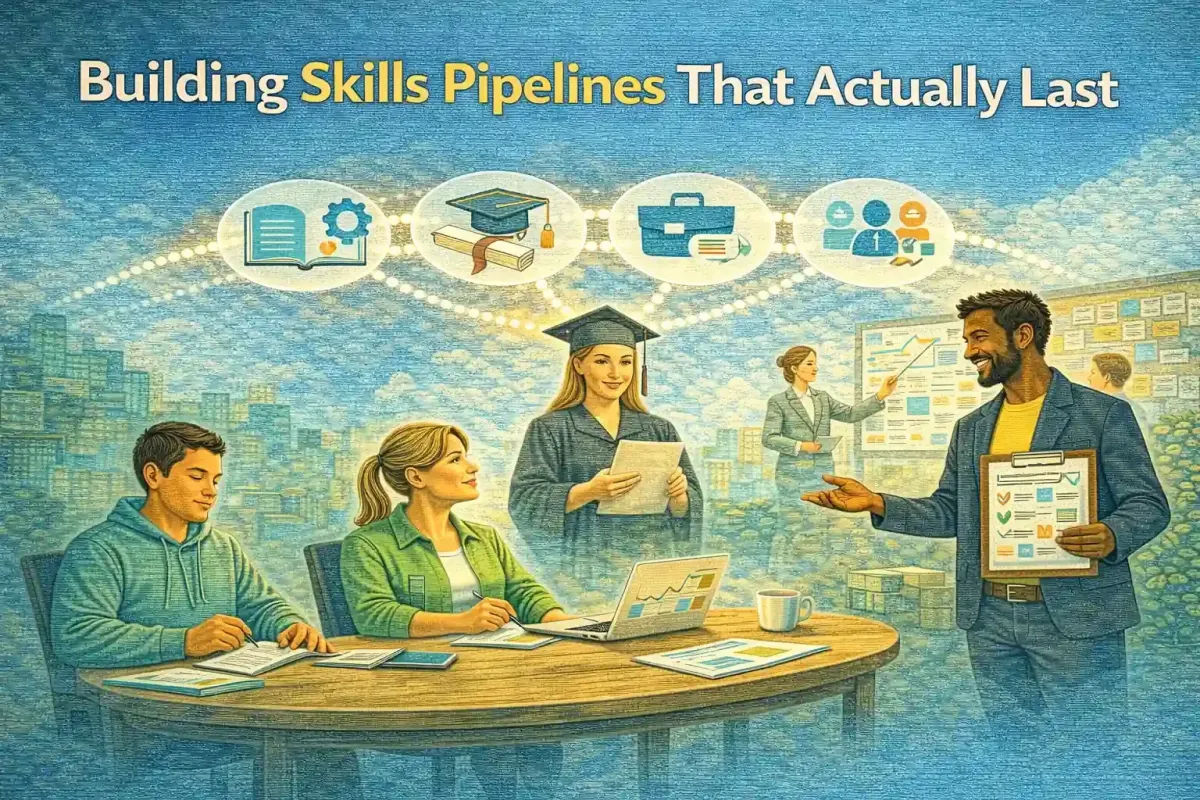
Building Skills Pipelines That Actually Last
Marketing platforms often talk about growth as if it begins at the moment a business hires its first manager. In reality, growth depends on a much longer chain of skill formation that starts well before anyone enters a boardroom. For organisations focused on sustainable visibility and operational scale, understanding how employment skills are developed, supported, and retained is not abstract theory. It is a practical concern with long-term consequences.
At GNR Media, conversations around strategy regularly circle back to one idea: systems outperform one-off efforts. The same logic applies to skills. When skills pipelines are fragile, businesses inherit gaps they did not create but must still manage.
The Hidden Fragility in Employment Skills
Employment skills do not emerge fully formed at the point of recruitment. They are shaped by access to education, stability at home, and early exposure to problem solving and communication. When those foundations are uneven, the effects surface years later as skills shortages, disengagement, or high turnover.
This is particularly visible in roles that demand judgment and clarity rather than rote execution. Communication breakdowns are rarely about tools. They are often the result of uneven early development that leaves people technically capable but underprepared for collaborative environments. From an industry perspective, this creates a quiet drag on productivity that cannot be fixed with software alone.
Marketing and growth teams feel this acutely. Scaling visibility requires people who can translate strategy into action and explain decisions across functions. When those abilities are inconsistent, growth becomes brittle. Internal friction rises, and leadership time is diverted from planning to patching.
Why Early Support Matters to Later Performance
From an employment and skills lens, the conditions that allow people to build confidence and focus during their school years have a direct relationship to workforce readiness. Organisations like Handshake Aid, an Australian charity supporting vulnerable public school students with essentials that help them stay engaged in education, illustrate how material stability intersects with long-term skill development. Their work is not about careers, yet its downstream effects shape who is able to participate fully in future workplaces.
For businesses, this connection matters even if it feels distant. Skills shortages are not only a training problem; they are an accumulation problem. When early barriers prevent consistent learning, employers later invest heavily in remediation. That investment often takes the form of leadership and communication support, including structured programmes focused on communication and influence skills, to help individuals operate effectively in complex environments.
These interventions are valuable, but they are also signals. They point to a system compensating for earlier instability and uneven access to learning.
What Sustainable Growth Teams Do Differently
Teams that scale without constant churn tend to treat skills as an ecosystem, not a checklist. They invest in clear processes, shared language, and realistic progression rather than assuming capability will simply appear with a job title. This approach aligns with how GNR Media frames growth: as something engineered through repeatable systems rather than bursts of effort.
Practical examples include documenting decision logic, normalising feedback, and allowing time for people to grow into responsibility. These practices reduce reliance on heroic individuals and make organisations more resilient to change.
For readers interested in how systems thinking applies beyond campaigns and into organisational capability, GNR Media’s perspective on sustainable marketing frameworks offers a useful reference point.
Employment skills are shaped by many actors long before a CV is written. Businesses cannot control that entire journey, but they can choose whether to ignore it or design with it in mind with care and long-term intent today.