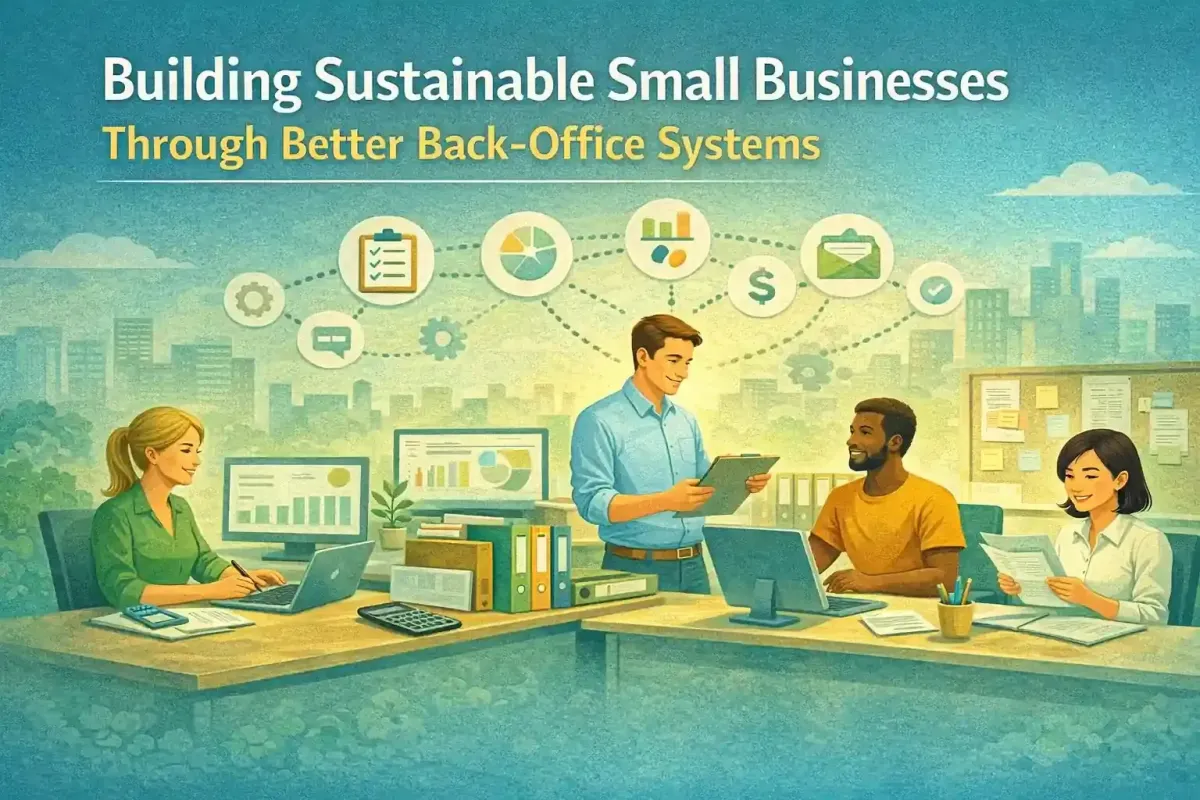
Building Sustainable Small Businesses Through Better Back-Office Systems
Small businesses rarely fail because the founder lacks ambition. More often, they stall because the internal machine can’t keep up with the external demand. A few extra customers, a new service line, or a seasonal rush can expose weaknesses that were always there—messy admin, unclear processes, delayed bookkeeping, and decisions made on incomplete information.
This is where sustainability becomes less about grand strategy and more about the quieter disciplines: structure, documentation, delegation, and routine. The businesses that last are usually the ones that treat their back office as a core operating system, not an afterthought.
At GNR Media, we often focus on visibility and growth, but long-term performance depends just as much on what happens after the enquiry comes in: how work is scheduled, how tasks are tracked, how finances are reconciled, and how responsibilities are shared without confusion.
Sustainability is operational, not just financial
When people talk about sustainability in business, they tend to mean profit margins, pricing, or market conditions. Those matter, but operational sustainability is what keeps a business functional through change—staff turnover, customer fluctuations, personal emergencies, or simply the slow build-up of workload.
Operational sustainability shows up in practical ways:
Work doesn’t live only in the owner’s head.
Critical tasks have a repeatable method.
Customers receive consistent service even when the business is busy.
Reporting is accurate enough to support decisions.
Admin doesn’t expand endlessly as revenue grows.
Without these foundations, growth creates pressure instead of stability. A business may look successful from the outside while becoming increasingly fragile on the inside.
A sustainable business is one where the systems can handle momentum. It’s not about removing the human element; it’s about reducing the number of moments where the business depends on one person remembering everything.
The hidden cost of “doing it later”
Many small business owners know their admin systems need improvement. They also know it’s not urgent—until it suddenly is.
The problem is that disorganisation is expensive in ways that don’t always appear in a spreadsheet. It can create:
Delayed invoicing and unpredictable cash flow
Missed follow-ups and lost opportunities
Over-servicing clients because boundaries aren’t clear
Burnout from constant task-switching
Tax-time stress that becomes a recurring annual crisis
Even competent teams can struggle in a business that lacks structure. When roles blur, tasks are duplicated or ignored. When processes are undocumented, every new staff member requires intensive training. When reporting is delayed, decisions become reactive.
This is why “we’ll fix it when things calm down” is often a trap. Things rarely calm down by themselves. More commonly, the business either stays permanently overloaded—or the owner caps growth to avoid the chaos.
Sustainability, in practice, often means building a business that can function at 80% capacity without panic. That breathing room is what allows improvement to happen.
Delegation as a sustainability strategy
Delegation is sometimes framed as a productivity hack. In reality, it’s a sustainability strategy. The goal isn’t simply to “get tasks off your plate,” but to create a structure where work can move forward without the founder acting as the central processing unit.
Delegation becomes sustainable when:
Tasks are defined clearly enough to be transferred
The workflow includes checking and accountability
Communication doesn’t rely on constant interruptions
The business has visibility over what is being done and why
This is where support roles—administrative, operational, and bookkeeping—can shape the long-term health of a business. Not because they “save time,” but because they make the business legible. They turn scattered tasks into trackable workflows and informal habits into documented processes.
For context, businesses may use external support models for administration and finance, including providers like team business, as part of building more stable operations without immediately expanding internal headcount.
What matters most is not the model itself, but the outcome: a business that can maintain quality, consistency, and compliance as it grows.
Sustainable businesses are rarely the loudest ones. They’re the ones that can keep going—through busy seasons, changing markets, and inevitable surprises—because the internal systems are strong enough to carry the weight.