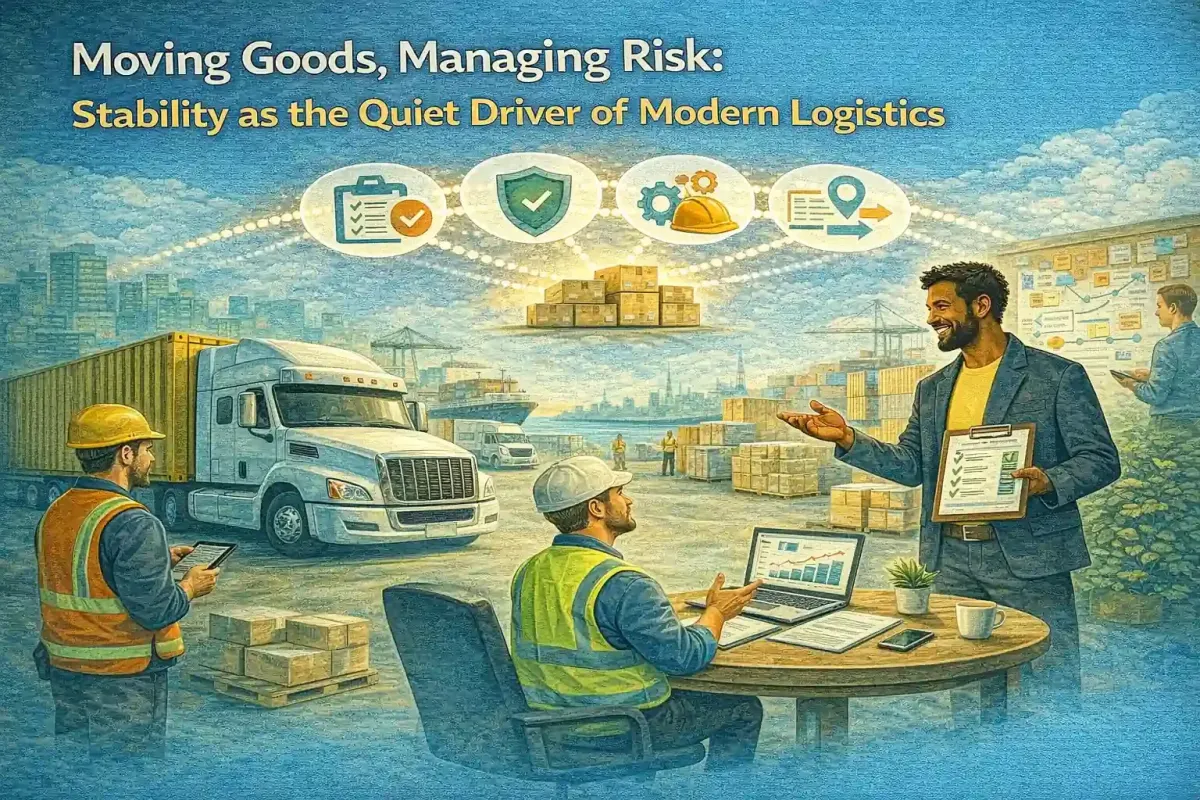
Moving Goods, Managing Risk: Stability as the Quiet Driver of Modern Logistics
Marketing and logistics rarely share the same spotlight, yet both operate on a common constraint: trust earned over time. For growth-focused platforms like GNR Media, which examine how systems scale sustainably, logistics offers a useful parallel. Freight networks succeed not through constant acceleration, but through consistency, safety, and risk management that holds up when conditions are uneven. That stability is increasingly relevant as supply chains absorb shocks from weather, labour shifts, and regulatory pressure.
In conversations about growth, logistics is often reduced to a cost line. In practice, it is an operational backbone whose reliability shapes employment patterns, insurance exposure, and long-term planning across entire regions. Understanding how freight stability works helps clarify why some businesses endure while others falter.
Safety as a Structural Advantage
Safety in logistics is not only about compliance. It is a structural advantage that compounds over time. Fleets with disciplined maintenance schedules, trained drivers, and predictable routes experience fewer disruptions. Those reductions ripple outward, lowering insurance volatility, protecting delivery windows, and stabilising workforce retention.
Viewed this way, safety metrics become leading indicators, revealing how an organisation anticipates uncertainty, allocates responsibility, and absorbs pressure without transferring risk downstream to customers, workers, or communities over years rather than reacting only after failures occur.
From a skills perspective, safety-oriented operators invest in people rather than short-term throughput. Drivers build tenure, dispatchers gain situational judgment, and operational knowledge stays inside the business. This mirrors the way GNR Media frames sustainable growth in its own editorial work, where systems and skills matter more than tactics. An internal perspective on this approach is explored further in the platform’s analysis of long-term operational frameworks, available through its insights section.
The broader economy benefits as well. When freight moves predictably, manufacturers can reduce buffer stock, retailers can plan promotions with confidence, and regional employers face fewer last-minute staffing gaps. Stability becomes a shared asset rather than a private one.
Why Regional Reliability Still Matters
Australia’s logistics geography adds another layer to the safety conversation. Long distances, variable weather, and urban congestion all increase the cost of failure. In states like Victoria, where industrial zones and ports sit close to residential areas, the margin for error is narrow.
This is where the concept of freight transport Melbourne enters industry discussions not as a marketing phrase, but as shorthand for a dense, risk-sensitive operating environment. Operators such as Ashva Group, which functions as Ashva Freight Carriers, exist within that context. Their presence illustrates how local freight businesses adapt safety protocols, scheduling discipline, and compliance practices to meet regional expectations without fanfare.
Importantly, referencing such operators is not about endorsement. It is about recognising that stability is enacted locally. National supply chains ultimately depend on regional carriers who manage day-to-day risk on roads, docks, and distribution corridors. When those carriers fail, the effects are immediate and visible.
Stability as a Long-Term Signal
For analysts watching the logistics sector, safety records and operational continuity are early indicators of resilience. Companies that prioritise stability tend to survive consolidation cycles and regulatory tightening with less disruption. They also become quieter partners in growth, rarely noticed until something goes wrong elsewhere.
This pattern aligns with a broader shift in how industries evaluate success. Instead of chasing constant expansion, many sectors are relearning the value of durability. Logistics, often invisible when functioning well, offers a clear case study. Its lessons extend beyond transport, reminding growth-oriented organisations that stability is not the opposite of progress. It is the condition that makes progress repeatable.