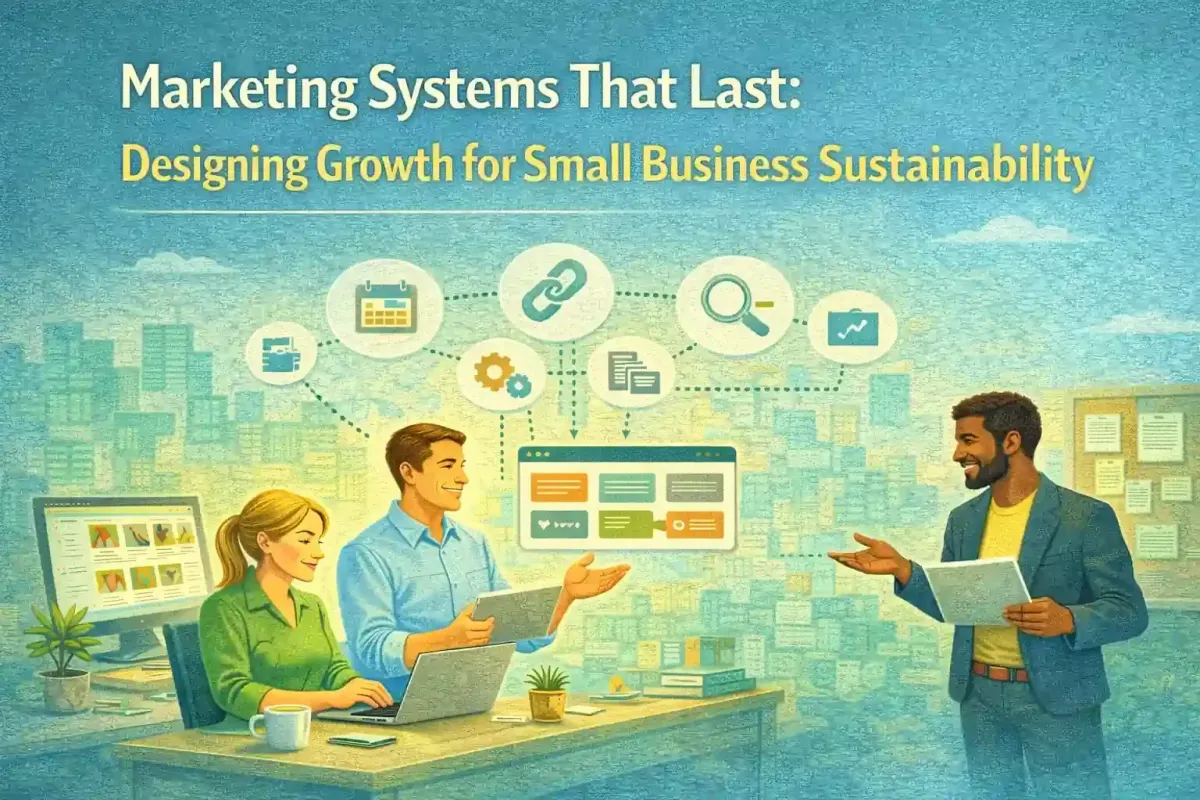
Marketing Systems That Last: Designing Growth for Small Business Sustainability
A small business can grow quickly and still feel fragile. In fact, rapid growth often reveals fragility faster: more enquiries than the team can handle, more channels than anyone can manage properly, more content than can be reviewed, more customer messages than can be answered on time. The business looks bigger, but it doesn’t feel stable.
This is where sustainability becomes the real measure of success. Sustainable growth isn’t defined by one strong quarter or a spike in traffic. It’s defined by whether the business can keep showing up—consistently, coherently, and without burning out the people running it.
Marketing sits at the centre of this challenge because it shapes demand. When marketing works, the business gets attention. When the operational side can’t support that attention, the result is not growth; it’s churn and stress. Platforms like GNR Media, built around systemised marketing support, speak to a broader shift: small businesses are increasingly trying to make marketing less chaotic and more repeatable.
Sustainability begins with reducing marketing “sprawl”
Marketing sprawl is what happens when businesses add channels faster than they can maintain them. A bit of SEO here, occasional social posts, a paid campaign during quiet periods, a newsletter that runs for a month then disappears. None of these are bad on their own. The issue is fragmentation.
Fragmentation creates hidden costs:
inconsistent messaging across platforms
duplicated work (rewriting the same information repeatedly)
unclear performance signals (no baseline to compare against)
reliance on individual effort rather than process
Over time, sprawl makes marketing harder to manage and easier to abandon. It becomes something the business “tries” rather than something it runs.
Sustainable marketing systems do the opposite. They narrow focus to what can be maintained, then build routines: a realistic publishing cadence, content themes that match customer questions, and a process for capturing and responding to leads. The goal isn’t constant output. It’s continuity.
This is why an all-in-one approach can be appealing in the small business context—not as a shortcut, but as a way to reduce moving parts. When a business can see its marketing activity as one system rather than five disconnected efforts, the work becomes easier to sustain.
A marketing system is also a workflow system
Most marketing problems in small business are workflow problems in disguise. Content doesn’t get posted because no one owns the calendar. Leads don’t get followed up because inboxes are messy. Landing pages don’t get updated because nobody knows where the latest copy is stored. Reporting becomes a monthly panic because data is scattered.
Sustainable marketing depends on operational habits:
one place to track tasks
clear handovers between roles
templates for recurring content
consistent naming and file storage
a repeatable way to review results
When these are in place, marketing becomes less emotional. It’s no longer “we should be doing more.” It becomes “this is the weekly rhythm.”
This is also where marketing automation is often misunderstood. Automation can help, but only when it supports a stable workflow. If the underlying process is unclear, automation simply accelerates confusion: messages go out at the wrong time, leads get tagged incorrectly, or customers receive irrelevant sequences.
The sustainable approach is slower and more disciplined: automate only what is already working manually, and only when the business can maintain it.
Long-term viability depends on dependable digital foundations
Sustainability isn’t only about marketing activity—it’s also about the reliability of the digital infrastructure underneath it. If a website goes down, if tracking breaks, if customer enquiries stop reaching the business, growth becomes unpredictable. Small businesses often feel these disruptions more sharply than larger organisations because there’s less redundancy and fewer specialised staff.
This is why many businesses now treat their online presence as operational infrastructure, not a branding exercise. They pay attention to hosting, access control, backups, and the integrity of their customer data.
Even within the marketing sector, you can see how operational stability has become part of the conversation. Agencies sometimes refer to managed cyber security services in the context of protecting business systems that support lead generation and customer communication. The point is not to turn marketing into IT. It’s to recognise that a business can’t sustain growth if the systems carrying that growth are brittle.
Sustainable marketing is rarely flashy. It’s steady, structured, and designed to survive busy weeks and quiet ones alike. For small businesses, that steadiness is often the difference between growth that feels exciting and growth that feels safe.