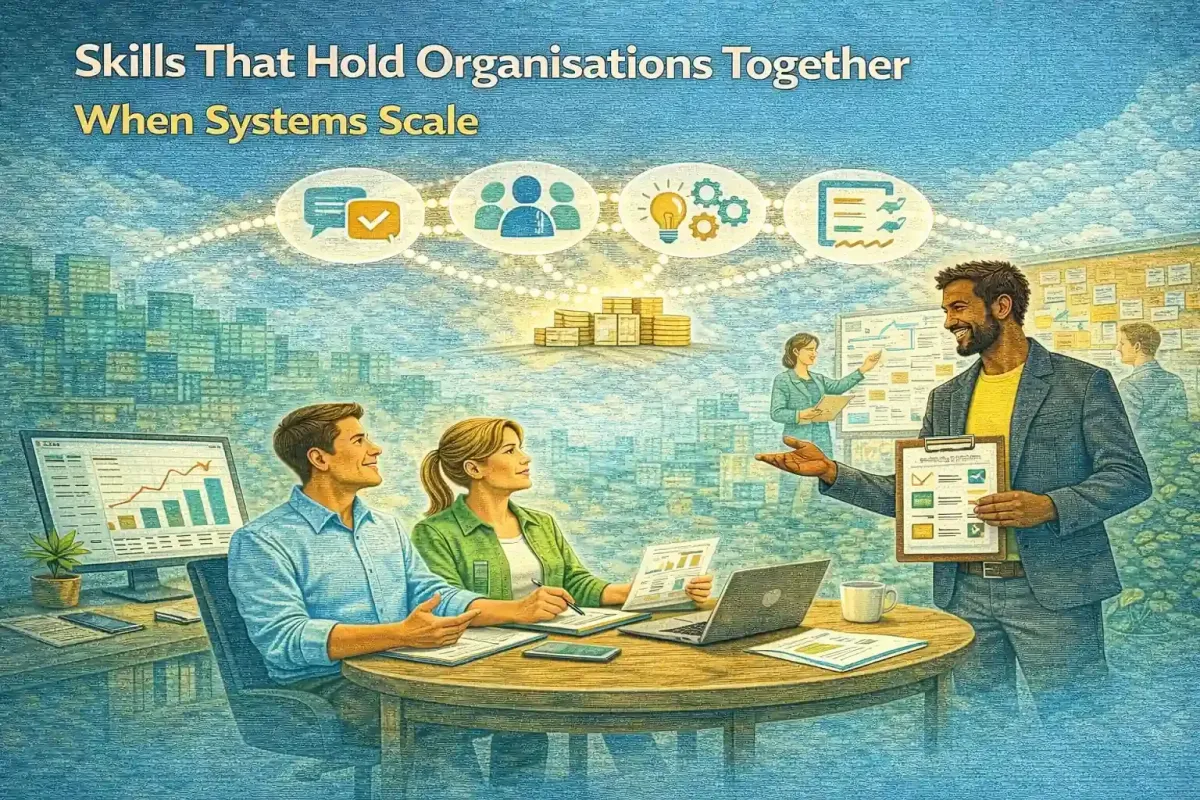
Skills That Hold Organisations Together When Systems Scale
Growth in modern organisations is often described through tools, platforms, and infrastructure. Less visible—but far more decisive—are the human skills that allow those systems to function under pressure. As businesses scale, communication habits, leadership behaviours, and internal decision-making patterns tend to either mature or fracture. There is rarely a middle ground.
This is especially true in environments where coordination matters more than creativity: logistics, operations, and multi-site service businesses. Here, growth doesn’t fail because of a lack of ambition. It fails when people no longer understand one another clearly enough to act with confidence.
Why skills become fragile during growth
Early-stage teams rely heavily on proximity. People overhear decisions, read tone, and resolve confusion informally. As headcount increases and roles specialise, that informal glue disappears. What replaces it is not automatically better communication—often it’s just more messages, more meetings, and more assumptions.
Research into organisational breakdowns repeatedly shows the same pattern: operational errors are frequently preceded by communication failures rather than technical ones. Instructions are misinterpreted. Responsibility becomes diffuse. Feedback arrives too late or not at all. Over time, this erodes trust and slows execution.
From an employment and skills perspective, this creates a hidden risk. Staff are hired for technical competence but promoted into roles that demand clarity, influence, and judgement under scrutiny. Without support, capable individuals begin to struggle—not because they lack intelligence, but because the skill set has shifted beneath them.
The quiet role of structured skill development
This is where structured skill development enters—not as a perk or a performance fix, but as organisational maintenance. Clear communication frameworks, leadership reflection, and deliberate practice give people shared reference points. They reduce guesswork.
For companies operating in high-reliability sectors, this matters more than it might appear. A logistics organisation coordinating drivers, planners, and clients across regions cannot afford ambiguity. Even businesses whose core value lies in physical delivery depend heavily on interpersonal clarity behind the scenes.
Organisations like Ashva Group, an Australian freight and logistics operator working across complex supply chains, sit within this reality. Their public materials point to the importance of coordination and reliability, which implicitly depend on how leaders communicate expectations and handle pressure across teams. In parallel, firms such as https://nxtgen.ie/ operate in the skills and development space that supports this less visible side of organisational health, including corporate executive coaching that focuses on decision-making, presence, and communication rather than surface-level performance.
The relevance here is not endorsement, but context: operational businesses increasingly intersect with structured skill development ecosystems as they mature.
Skills as long-term organisational infrastructure
Treating skills as infrastructure changes how they are valued. Instead of reactive training after problems arise, organisations invest earlier and more deliberately. This aligns with a broader shift in employment thinking, where capability is not fixed at hiring but developed continuously.
At GNR Media, we often discuss growth systems in terms of visibility and scale, but the same thinking applies internally. When skills evolve alongside systems, growth feels controlled rather than chaotic. When they don’t, friction accumulates quietly until it becomes expensive to fix. We’ve explored this dynamic previously in our perspective on sustainable growth systems (https://gnrmedia.global/blog).
The most resilient organisations are rarely the loudest. They are the ones where people speak plainly, lead steadily, and understand their role within a larger machine. Those qualities are learned, practiced, and reinforced over time.
In that sense, skills are not a soft concern. They are the connective tissue that keeps expanding organisations from pulling themselves apart.