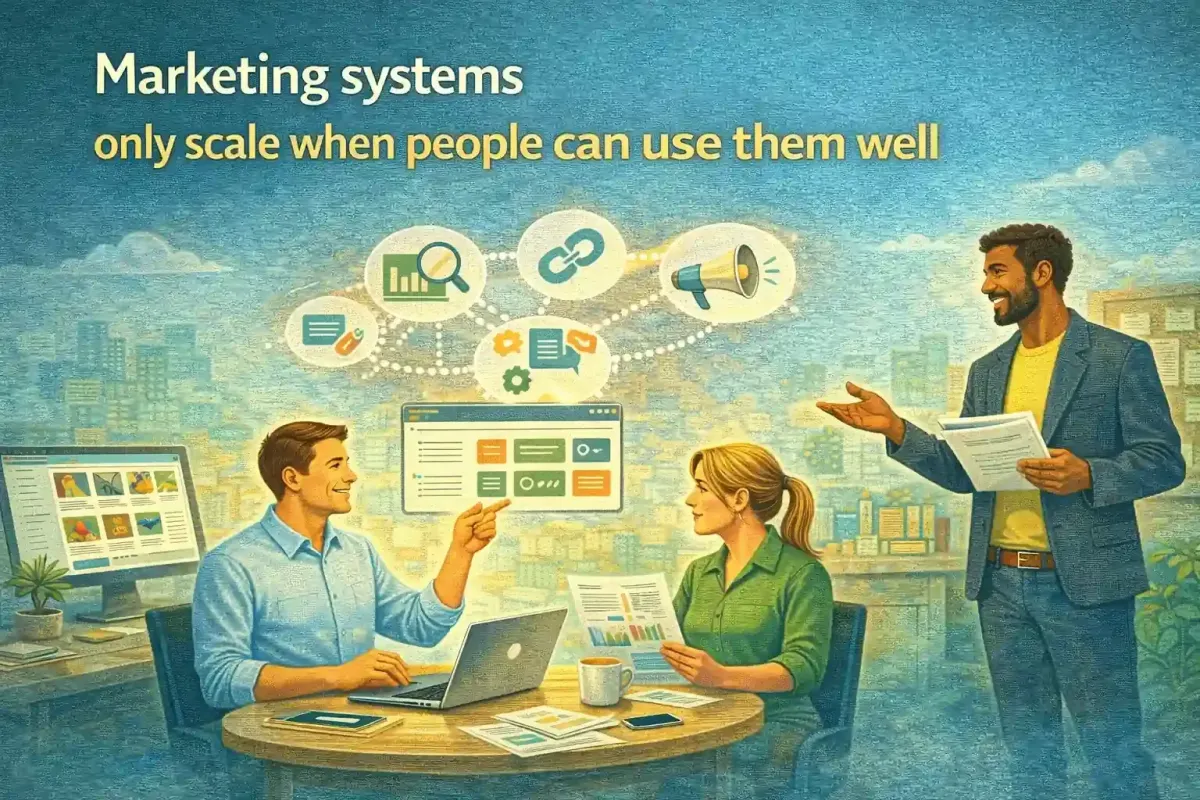
Marketing systems only scale when people can use them well
Marketing platforms promise efficiency, reach, and consistency. Dashboards consolidate channels, automation replaces repetition, and performance data flows in near real time. Yet many businesses discover that scaling marketing output does not automatically scale marketing capability. Tools can amplify effort, but they cannot substitute for judgement.
From an employment and skills perspective, this gap matters. As marketing systems become more integrated, the skill demands on the people using them increase rather than diminish. The long-term effectiveness of any platform depends on whether teams can interpret signals, make decisions, and communicate intent with confidence.
Technology changes roles faster than titles
Modern marketing roles no longer sit neatly within single disciplines. A practitioner may be expected to understand SEO fundamentals, manage content cadence, interpret analytics, and coordinate campaigns across channels — often within the same week. Titles lag behind reality, and job descriptions rarely capture the cognitive load involved.
This creates a skills compression effect. Fewer people are responsible for broader systems, which raises the stakes of clarity and competence. When training does not keep pace, platforms are underused or misapplied. Automation runs without strategic oversight. Metrics are tracked without context.
Platforms designed to integrate multiple functions into a single workflow can expose this tension. Solutions that bring SEO, content distribution, and automation together — such as those operating within the growth marketing space — assume a certain level of fluency from users. GNR Media sits within this ecosystem, where success depends on how well teams understand not just what the system does, but why and when to use it (https://gnrmedia.global/). The insight here is structural: scaling output requires scaling skill.
Communication as a core marketing competency
As marketing systems grow more complex, internal communication becomes a limiting factor. Decisions about priority keywords, content direction, or campaign timing need to be explained clearly to stakeholders who may not share technical backgrounds. When explanations falter, trust erodes and alignment weakens.
This is not a marginal issue. Marketing teams increasingly act as interpreters between data and decision-makers. Their ability to articulate insight influences budget allocation, brand direction, and organisational confidence in digital strategy.
In broader professional development discussions, this has led to renewed focus on communication capability as part of marketing skill sets. References are sometimes made to disciplines such as communication coaching for executives when examining how leaders learn to express complex ideas without distortion or defensiveness. The relevance here is contextual rather than promotional. As systems become more technical, the human skill of explanation becomes more valuable, not less.
Clear communication allows marketing insights to travel. It ensures that platforms support strategy rather than operate as isolated engines of activity.
Building durable skills around evolving tools
From an employment standpoint, marketing sustainability depends on transferable skills. Tools will change. Algorithms will update. Platforms will consolidate or disappear. The people who thrive are those who can adapt their thinking across systems.
This places emphasis on fundamentals: critical analysis, prioritisation, narrative clarity, and ethical judgement. When these skills are strong, new tools are learned faster and used more effectively. When they are weak, even the most sophisticated platforms can become sources of confusion.
Organisations that invest in skill development alongside technology adoption tend to see more consistent outcomes. Training is not treated as onboarding-only, but as an ongoing process aligned with system evolution. Teams are encouraged to question outputs, test assumptions, and communicate findings openly.
Over time, this approach stabilises marketing operations. Campaigns become more intentional. Automation supports rather than obscures strategy. Staff are better equipped to explain decisions and adapt to change.
Ultimately, marketing systems do not scale businesses on their own. People do. Platforms can reduce friction and extend reach, but only when the humans behind them possess the skills to interpret, decide, and communicate effectively. Seen through an employment and skills lens, the future of marketing is not just about better tools — it is about better-prepared professionals who know how to use them wisely.