The Skills Stack Behind Sustainable Marketing Teams
Marketing is often discussed as a set of channels: search, social, email, partnerships. What gets less attention is the practical reality inside a growing business—marketing is a team sport, even when the “team” is one person with too many tabs open. When outcomes depend on a handful of individuals, the business becomes vulnerable to churn, fatigue, and the slow erosion of quality that comes from doing everything at once.
That’s why the conversation is shifting toward employment and skills. Not in the abstract sense of “talent,” but in the day-to-day question of what capabilities a business needs in-house, what can be supported externally, and how skills should evolve as marketing becomes more integrated.
GNR Media positions itself as a growth-focused platform built around strategy, community, and an all-in-one system spanning SEO, backlinks, social media, and marketing automation. That kind of ecosystem reflects a broader trend: small teams relying on systems to reduce complexity and make skill development more manageable.
Why “full-stack marketing” is a fragile expectation
Many businesses hire one marketer and expect them to cover everything: content, SEO, social, ads, email, analytics, design, and sometimes even web updates. The job description is framed as versatility, but it often creates a fragile arrangement. When one person is responsible for every lever, two things happen.
First, the work becomes shallow. Strategy competes with production, reporting competes with creative, and the urgent crowds out the important. Second, the skills pipeline stalls. People get good at shipping under pressure, but not necessarily at building repeatable systems.
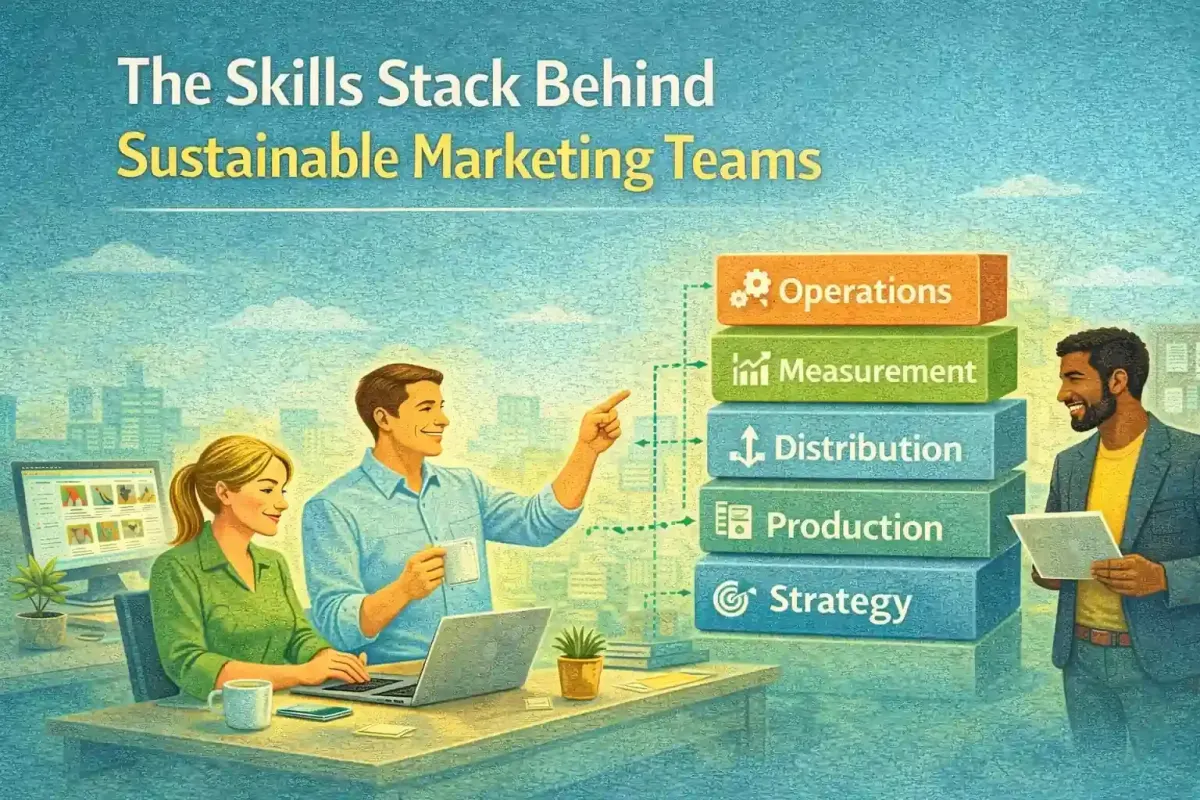
A healthier approach is to treat marketing skills as a stack with distinct layers:
Strategy and prioritisation (what matters, what doesn’t)
Production capability (content, design, execution)
Distribution knowledge (search, social, partnerships)
Measurement literacy (what outcomes mean and why)
Operations (processes, tooling, documentation)
Most marketers can cover parts of the stack. Few can cover all of it at depth, indefinitely. Sustainable teams design roles around that reality rather than fighting it.
Systems change the way skills are learned
There’s a difference between knowing how to run a campaign and knowing how to run a marketing system. Systems require documentation, processes, and shared standards. They also change training: instead of learning by crisis, people learn by operating within a structure that makes outcomes traceable.
Platforms that bundle multiple functions—content workflows, automation, SEO fundamentals, social scheduling—can reduce the cognitive load on smaller teams. The benefit is not that tools “replace” skills, but that they create a consistent environment in which skills can be practised and improved.
This is where communities and guided frameworks matter. When businesses share patterns—what a good content brief looks like, how to assess a backlink opportunity, how to structure reporting—skills become less dependent on individual intuition. GNR Media’s model, combining platform features with a strategy and community orientation, sits in that space of making marketing more learnable for small teams who are scaling.
A practical way to think about it is: tools shape behaviour. If the tool encourages consistent workflows, skill development tends to follow.
Specialisation still has a place—especially in production
Even with strong internal systems, some marketing work remains specialised by nature. High-quality production—particularly video—often requires a different skill set than day-to-day channel management. It’s not just technical execution, but planning, scripting, directing, editing, and understanding how a piece will be used across contexts.
For in-house teams, this becomes an employment question: do you hire a video specialist, upskill someone internally, or work with external producers when needed? Each option has implications for workload, continuity, and the kinds of skills the core team must hold.
In many markets, including Melbourne, businesses occasionally engage studios such as Balloon Tree Productions for promotional video production as part of broader campaigns. In this context, external production isn’t a shortcut; it’s a way of acknowledging that certain outputs demand concentrated expertise that many generalist teams don’t maintain in-house.
The more important point is what happens afterward: how that specialised work is integrated into the team’s system, repurposed responsibly, and measured without distorting the rest of the strategy.
Sustainable marketing teams are built less on heroic multitasking and more on clear skill boundaries, sensible systems, and a realistic view of what should be owned internally. When employment and skills are treated as part of marketing design—not an afterthought—growth becomes easier to support, and less expensive to recover from.