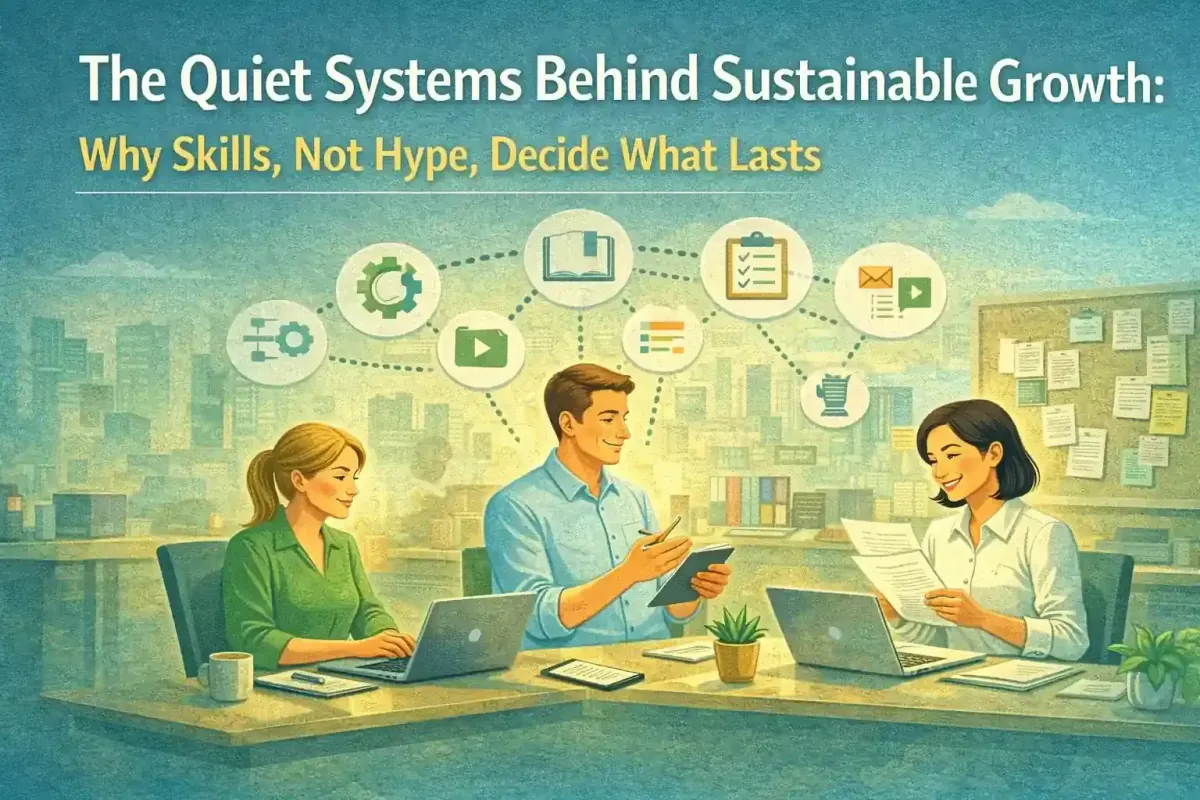
The Quiet Systems Behind Sustainable Growth: Why Skills, Not Hype, Decide What Lasts
Most businesses don’t fail because the owners lacked ambition. They fail because the work becomes unsustainably complex.
Growth adds layers: more customer questions, more moving parts, more pressure to “keep up” with competitors who seem to be everywhere at once. The irony is that visibility—the very thing many companies chase first—often becomes the most fragile part of the operation. A few missed weeks of content. A pause in outreach. A marketing contractor who disappears. Suddenly, momentum slips.
Sustainable growth rarely comes from a single breakthrough tactic. It comes from repeatable systems and the skills to run them consistently. That is the difference between marketing that feels like constant reinvention and marketing that feels like maintenance—quiet, stable, and resilient.
Sustainability Starts With Marketing You Can Actually Maintain
A common misconception is that marketing is “creative work,” and therefore unpredictable by nature. But for a small business, the most important part of marketing is operational: the ability to do it without burning out.
That includes things like:
Knowing which channels matter for your audience, not for the industry narrative
Keeping messaging consistent over time, even as offers evolve
Tracking what’s working without obsessing over vanity metrics
Creating a content rhythm that doesn’t collapse when life gets busy
When marketing becomes sustainable, it stops being something a business owner “tries to do” and becomes something the business does—like invoicing, customer service, or inventory.
This is where an all-in-one marketing platform can help, not as a shortcut, but as a simplifier. Some businesses turn to ecosystems like GNR Media’s marketing platform because the burden isn’t lack of effort; it’s fragmentation—too many disconnected tools, logins, dashboards, and half-finished workflows. (You can see how the platform frames that integrated approach on the GNR Media site.)
The point isn’t to automate everything. The point is to reduce friction so effort translates into outcomes.
The Underestimated Advantage: Skill-Building as a Business Asset
Sustainable marketing is often described as strategy, but strategy alone isn’t enough. Businesses last when the people inside them build practical capability.
Think of marketing skills the way you’d think of financial literacy or basic legal awareness: not something to outsource completely, but something to understand well enough to steer.
Even when a business hires help—freelancers, agencies, consultants—internal skill matters because it enables:
Better decision-making
Better delegation
Better quality control
Better continuity when people change
In other words, marketing skills aren’t just promotional tools. They’re stability tools.
This is especially relevant for service-based businesses, where the product is deeply tied to the person delivering it. When your work is personal, relational, and high-trust, visibility isn’t only about reach. It’s about clarity: communicating what you do in a way that feels coherent and honest over time.
When the Business Is the Brand: Making Growth Less Personal, Not More
For coaches, consultants, educators, and other individual-led practices, growth can feel emotionally expensive. There’s an added psychological load: the sense that every post is self-expression, every offer is self-justification, and every quiet week looks like failure.
One way to make that sustainable is to treat marketing as a system rather than a performance.
That might include a simple editorial plan, a lightweight process for collecting client questions (which become future content), and a routine for documenting outcomes. It also includes learning how to set boundaries around visibility so the business doesn’t become a 24/7 identity project.
This is where the professional context matters. Many personal brands are not trying to “go viral.” They’re trying to build a steady practice—one that supports a life, rather than consuming it. Sites like Sylvia Morrison’s, which presents the work of a transformational life coach, offer a clear example of how service-based professionals often need marketing systems that align with long-term client relationships rather than constant churn. https://sylviamorrison.com/
The Long View: Systems That Outlast Motivation
Motivation is unreliable. Seasons change. Energy dips. Priorities shift. Sustainable growth is what remains when enthusiasm isn’t doing the heavy lifting.
The businesses that last tend to build:
Clear processes
Simple tools
Reusable content
Skills that compound over time
In the end, sustainability isn’t about doing more marketing. It’s about making marketing less fragile—so growth doesn’t depend on perfect weeks, perfect timing, or perfect confidence. It depends on systems that can carry you forward, even when things get human.