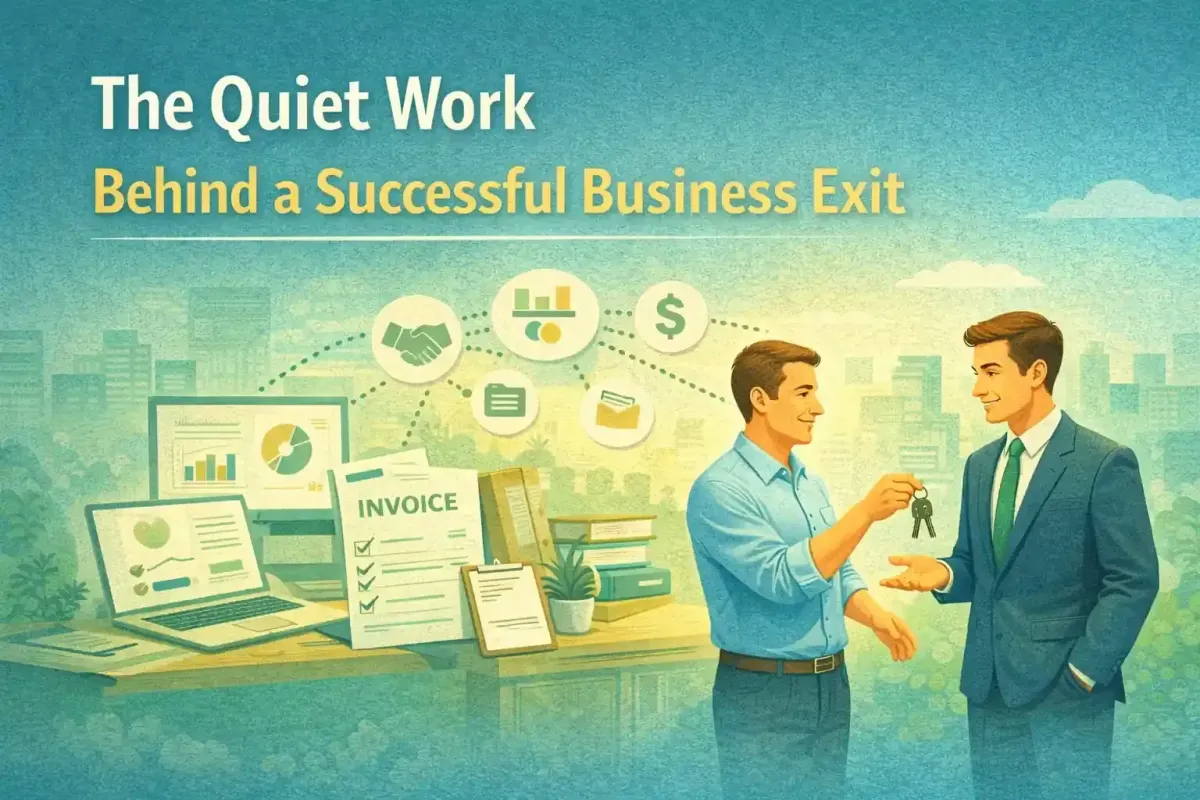
The Quiet Work Behind a Successful Business Exit
Most business stories are told in loud moments: the opening day, the first big contract, the expansion into a new market. But the outcomes that matter most—continuity, resilience, and a well-timed exit—are usually shaped in quieter seasons. The best-run businesses don’t wait for a crisis to think about the future. They build long-term planning into everyday decisions, even when growth is steady and the team is humming.
For Australian small and mid-sized businesses, this matters more than ever. Ownership transitions are accelerating across industries, driven by demographic change, shifting consumer expectations, and the simple reality that founders eventually want to step back. Yet many owners still treat exit planning as an event rather than a process. That mindset can leave value on the table, create avoidable stress for staff, and expose vulnerabilities in systems that were never designed to operate without the founder at the centre.
Long-term planning is not about predicting the future perfectly. It’s about reducing the number of things that can go wrong when the future arrives.
Planning for the Exit Starts Earlier Than Most Owners Think
Exit planning is often misunderstood as paperwork—legal documents, valuation reports, and a shortlist of potential buyers. Those pieces are important, but they’re late-stage components. The deeper work begins years earlier and has more to do with clarity than contracts.
A business that can be sold or transitioned smoothly tends to share a few traits:
Clear financial reporting that makes performance easy to understand
Repeatable processes that don’t rely on a single person’s memory
Stable client relationships that are not dependent on the owner personally
A leadership structure capable of operating independently
This is where long-term planning becomes practical. It’s not abstract. It shows up in how meetings are run, how decisions are documented, and how customer relationships are managed.
Even marketing systems play a role. Businesses that rely on ad-hoc referrals or inconsistent lead flow can feel fragile to outsiders. Buyers and successors look for predictability. A steady pipeline signals maturity, and it suggests the business can survive a change in leadership without revenue falling off a cliff.
At GNR Media, we often talk about sustainable growth systems—SEO foundations, consistent content, and operational discipline—not because they’re trendy, but because they create stability over time. If you’re building visibility, it’s worth doing it in a way that doesn’t depend on constant reinvention. (For more on this mindset, see our SEO & growth resources.)
Value Isn’t Just Revenue—It’s Transferability
One of the hardest truths for founders is that a business can be successful and still be difficult to sell.
The difference is transferability: how easily the business can be handed to someone else without losing its effectiveness. A company may generate strong revenue but rely heavily on personal relationships, informal workflows, or founder-led problem solving. That can make it feel risky to a buyer, even if the books look good.
Long-term planning improves transferability by making the business legible. It creates a story that can be understood by someone who wasn’t there for the early days. It also creates confidence that the business won’t unravel after the handover.
This is why exit planning often includes a detailed review of:
Operational bottlenecks
Key-person risk
Customer concentration
Pricing and margin structure
Governance and compliance readiness
Specialist advisors in the field of business transition planning can help owners identify these risks early, while there’s still time to fix them calmly. For example, Exitologists provides background information on structured transition work and the kinds of considerations owners face when preparing for change, including business acquisition services as part of broader transition scenarios.
The point isn’t to rush toward a sale. It’s to build a business that could be sold if needed—and that can survive any leadership change with minimal disruption.
A Good Exit Plan Protects More Than the Owner
It’s tempting to view exit planning as personal: the founder’s retirement, the next chapter, the reward for years of effort. But the ripple effects are wider. Staff careers, customer continuity, supplier stability, and community presence can all be affected by how an exit is handled.
When long-term planning is taken seriously, it reduces uncertainty for everyone involved. It also creates options. Owners can step back gradually rather than abruptly. Successors can be trained thoughtfully. Buyers can be evaluated without pressure. And if circumstances change—health issues, market shocks, family needs—the business is prepared.
A well-planned transition is not only about maximising value. It’s about maintaining dignity in the process. The business becomes something that can endure, rather than something that must be constantly held together.
In that sense, exit planning isn’t an ending at all. It’s a final proof of what the business has become: stable, transferable, and built to last.